Sunday, 29 April 2012

EXPATRIATE WORKERS: TO HIRE OR NOT TO HIRE?

Evening Everyone, I hope you all had a relaxing weekend and are ready for the fantastic week ahead? I've been thinking about a few things this weekend and one of them is the issue of hiring workers in Nigeria. There were a few heated debates about the issue of foreign workers "stealing our jobs" and I couldn't have disagreed more vehemently (and believe me I did...nothing like a heated debate to get the blood pumping! lol) As someone who has worked both locally and internationally, I fully support the right of an employer to hire the best candidate irrespective of race, creed, colour, or ethnic background. Finding someone with the right skills, competencies, and cultural fit are some of the most important factors in personnel recruitment and I have never seen an instance where an "outsider" didn't fit in perfectly and excelled above and beyond their call of duty.

However, i know views differ. Yesterday I stumbled across an article on the Internet (vanguard Online  Newspaper) about hiring expatriates in Nigeria. an excerpt can be found below:

THE issue of the upsurge in hiring expatriates and expatriate quota abuse in Nigeria has remained topical in the nation's employment system. Organised labour, civil society groups and other concerned Nigerians have continued to see the increase and abuse as not only an economic crime, but also compounding the employment crisis in the country. In this interview, Mr. Femi Mokikan, the Executive Director, Human Resources, 7UP Bottling Company Plc, gives reasons for the increasing intake of expatriates in Nigerian economy:

Excerpts from the interview: The issue of expatriate quota, if you allow me, I will speak generally. I know I was at Nigeria Employers Consultative Association, NECA, and I was chairman, Human Resources committee for a while, and this issue featured prominently to a point where we even had to go to the Federal Ministry of Labour in Abuja. Initially, the idea was, no expatriates, then later it became these expatriates should not do particular kinds of jobs. I do not think there is any economies in the world that can say do not use other nationalities. So, that one is not what anybody is talking about. I think the question people usually ask is; why should expatriates be taking on jobs that Nigerians can do? I think our educational system in this country has not helped us too. I am speaking as a Nigerian; I am also speaking as an employer of labour that is operating in an environment that is extremely competitive, an environment where technology changes as you blink you eyes. That is why such areas where we used to pride ourselves as being capable as Nigerians, we now have to ask ourselves, how well can Nigerians do this?
 When investors bring in their money, they expect maximum returns. Even though it would cost a bit more, they would rather get an expatriate than a Nigerian who will give minimum returns. I think that is what is happening in the area of expatriates' employment generally.Question: How will you respond to those that claim 7UP Bottling Company is one of the companies that abuse expatriate quota? 

A. Engineering today has moved from pneumatic to electrical electronics. Most things are electrically driven, including the trucks we use. Everything today is electronics, you just press buttons. You go to the production line, you just see buttons. But as we are upgrading those technologies, we also need the people. For example, we moved from diesel powered generators, because we thought diesel was becoming something else, so expensive. So, we moved to gas, not that we did a conversion, we bought brand new generators. Of course, we do not have the technology in terms of the personnel. But as installation was taking place, kidnappers came. In fact, when we first started hearing of kidnappers, we got a mobile policeman. The kidnappers killed the mobile policeman, carried his corpse and put him inside the vehicle, poured petrol and burnt it. After that experience, the expatriate, till tomorrow, where he is, if he hears 'Ni' he will not wait for 'geria'. The next opportunity we had to bring the expatriates to Lagos, they did not stay. They were still doing installation, we had not even finished, they just left and we were back to square one. We went to Egypt to see if we could find expatriates there, none of them wanted to come. We devised another strategy to have quarters within the premises so that whoever that is coming, he will enter that place. It is like you are going to a concentration camp. During the interview, we told them that their supermarket and everything was programmed. We also made it a point of duty to let them know that they must be ready to teach Nigerians. Some of them were not willing to transfer this knowledge. Those ones just like some Nigerian managers who will also not want to teach others for fear that if the student knows too much, he may take over the job..."  http://odili.net/news/source/2012/apr/12/324.html

Hmm...

Although I have never believed the answer to Nigeria's manpower planning problem was the hiring of expatriate workers,I firmly believe in hiring the right person for the job. If the requisite skills and competencies cannot be found locally, why not recruit internationally, subject to salary and the financial justification of hiring internationally? The bottom line is getting the right person for the right job...or isn't it? Nigeria is a diverse nation with millions of opportunities and enough space for everyone, just like any other developed and developing nation...or isn't it?

And as for an abuse of the system, who exactly is responsible for this and why do you think abuse of the system happens?

What are your thoughts readers?

Friday, 27 April 2012

FREE ONLINE LEARNING

Hi guys, I'm always looking for opportunities to learn or enhance my skills and abilities to promote myself as a consultant because the world we live in now is so dynamic. I truly believe that we are all responsible for our happiness and can act as our own changes agents for a brighter tomorrow. while researching on the internet i stumbled on the below link:


This is appears to be an online learning academy called ALISON and they advise they've run over 50 million learning programs since they commenced!!! So why not take out some time this evening to explore them as I plan to and take some courses in skills you want to learn but have not budgeted for in terms of training.

Make sure you write back and let me know if you were able to sign up and learnt anything useful.

Have a great week.

Wednesday, 25 April 2012

FREE EVENT IN LAGOS - GOOGLE

http://www.bellanaija.com/2012/04/19/register-today-for-the-2012-get-nigerian-businesses-online-web-fair-a-gathering-to-help-promote-smes-online/

DEAR NIKKY...WHY MUST I CONFORM TO THE DRESS CODE?!?!

Last week I got a text from a friend who recently started working somewhere new. She wrote "Hi Nikky, after a really stressful banking career, i decided to resign and now I'm working in an architectural firm. After the induction, HR tells me there is a dress code. This is really pissing me off. I was hired to do drawings, Why do I need to conform to a dress code?

Many a times, a lot of us start work somewhere and realise there is a spoken or unspoken dress code that everyone conforms too.  The dress code usually lets you know what is acceptable in the office and more about the office culture and norms. I told my friend first things first, ‘your boss pays your salary” fighting this battle is not only pointless but irrelevant because it is a losing battle. I also told her that she was looking at it from the wrong perspective. I love it when an office has a dress code simply because it tells me more about the office and it's boss. For example, a client I was consulting for had such a thing about dressing stylishly that on my second day; I was given a dress allowance and given the day off to shop. You may say wow!! Good for you but honestly this action would have made sense if I wasn’t a fan of snazzy dressing myself and my job involved me being his in house consultant in a back office where I was organising his paperwork and archives and where I had limited communication with colleagues and no contact with his clients. In that instant, I realised for him, image was everything… to the detriment of everything else, including work (after all a day off on day 2 on a paid consultancy job with a deadline???) and other people's opinions or feelings. It also suggested that if it was my opinion versus his, his would win hands down not out of stubbornness but simply because that was his default way of doing things. Alas, ten days later I was proven right but I had taken the right steps in order to save both me and him any embarrassment and a possible confrontation.

For those of us wondering why certain things are normal in our offices such as a dress code or the boss insisting on all work chairs being put at a particular level in the office or deducting salaries when a worker is spotted eating ANYTHING on the office floor, instead of complaining bitterly at the tyranny of it all, why not take some time out today to ask yourself WHY these rules have become normal. Asking yourself questions about what your boss tolerates and doesn’t tolerate will give you better insight into how they operate at work, their expectations, and possible pitfalls you may find yourself in during the course of your career which can only hopefully positively impact your work and hopefully salary . On that note ladies and gentleman Ill tell you what I told her, if the order of the day is three piece suits and black shoes only (heels optional) wear them with style, find a way of expressing yourself through your clothing, and don’t forget, there is a reason why that particular dress code exists, take some time out today to learn why and you could possibly find out you may need to hone in on a particular skill or ability to get ahead.

Also, Look at the dress code as an opportunity to fill your wardrobe with new pieces that will shake you out of your comfort zone and endear you to a whole new set of people which will increase your like-ability and hopefully positively impact both you as a brand and as an employee. Don’t waste you and HR’s time and energy wearing pieces that earn you queries, trips home, and a possible termination of hire as soon as you slip up and do something wrong that could have earned you a lesser punishment. If you have that much of a problem with an outfit, then maybe you should reconsider where you are and set up shop somewhere else.

Have a great evening everybody!!

Tuesday, 24 April 2012

PRACTICAL STRESS MANAGEMENT TIPS TO USE AT WORK


You call your customer who owes you ten million Naira and his secretary informs you he has left the country for the next six months...your team lead decides to change the entire strategy of assignments due within the few months and you were not consulted...the inverter and generator blows at work and there is no light for 5 days, your customers start calling to hurl abuses and you are losing tens of thousands of Naira daily....Your blood pressure shoots up, you’re dizzy, you are seeing stars, you’re screaming at you’re colleagues, and fighting with taxi drivers and food sellers...

I hate to tell you this but you sound mighty stressed out to me!!

However, as Type A personality prone to outburst and stressed induced headaches, I can tell you yes you may be suffering from stress, but you can make it work for you and not against you. Interacting with colleagues and subordinates has taught me a few things about successfully stress management and below I have summarised my personal strategy in a few steps that can be applied right here in Nigeria, irrespective of where or who you work for:

  • Acknowledge the stress
Just as it takes more energy to smile rather than frown, it takes more energy to deny a problem than acknowledge it. Yes you are upset, yes things are not going your way. Yes you may have just received the biggest shocker of your life, but don’t go into denial mode. When you hear bad news or are in a tricky situation, don’t beat yourself up. Embrace the initial shock, lower your eyes, and count to ten. You are calming yourself and gathering yourself. Remember the anticipation of death is worse than death itself..there is no situation you cannot overcome.
  • Look at the root and not the problem itself
OK now, lets see what happened. Between you and the wall in front of you, are you responsible for what happened? Did you see it coming and look away? Did you know your colleague or customer was a flaky individual and depended on them when you shouldn’t have? Problems have a way of repeating themselves, why not take a honest look today at what is stressing you so that you can start working on solving the root cause of your stress.
  • Take responsibility for improving your physical and emotional well-being.
Its easy to say I’m to busy to exercise, eat the right food, or talk to a friend but I am here to tell you the truth. That is a bold face lie and lazy person’s way of dealing with stress. Fruits and vegetables that will help give you energy and cleanse you system must be taken. It costs nothing to walk round your office or take a twenty minute walk at home while listening to music. Learning how to stretch and do yoga at your desk will help your breathing and lower your blood pressure. Take ownership of your health today.
  • Avoid pitfalls
They say it’s madness to keep doing the same thing expecting a different result each time.  This applies for dealing with stressful situations. Screaming at your colleague every time she is late when you know she has a problem with time keeping will make her immune to your shouting and hurt you more than her. In Nigeria, we seemed to have stopped using our brain and observing our surrounding in order to recognise and avoid certain problems. Most times stressful situations repeat themselves and a wise man would be the one to study each incident to both avoid them in future and deal with them if they ever arise again.
  • Learn better communication skills
Today’s world is more fast paced, dynamic and work systems are flatter but the same culture, economic, and political problems are still being grappled with making the work environment a tricky place. For example, how workers balance their beliefs about age and respect when dealing with a manager ten years younger than themselves? Or a 45 year old indigenous worker reporting to a 28 year old expatriate? Or the 20 year old nephew of the boss who thinks he is untouchable? 

Do you know what it means when your colleague looks at his watch when you are talking? What about if I remain standing and tell you to sit on a chair? What if as I’m standing I fold my arms stand in front of you and lean into your personal space? Being able to communicate while remaining polite and diplomatic and reading your surroundings and non verbal queues of your colleagues, bosses, and business owners is no longer a luxury, it’s a must.If you have no idea what I’m talking about, I’d suggest you make sure you read my upcoming articles about business communication.

When stress at work interferes with your ability to perform in your job, manage your personal life, or adversely impacts your health, it’s time to take action. Start by paying attention to your physical and emotional health. When your own needs are taken care of, you’re stronger and more resilient to stress. The better you feel, the better equipped you’ll be to manage work stress without becoming overwhelmed.Taking care of yourself doesn’t require a total lifestyle overhaul. Even small things can lift your mood, increase your energy, and make you feel like you’re back in the driver’s seat. Take things one step at a time, and as you make more positive lifestyle choices, you’ll soon notice a reduction in your stress levels, both at home and at work.(www.helpguide.org/mental/work_stress_management.htm)  

I encourage you to answer honestly and complete the text. If you finish the test and find you are experiencing high job satisfaction, then congratulations! If you are at risk of experiencing burn out, i would still congratulate you because you are now on your way to solving the problem by first acknowledging the issue.

If you want more information about coping with stress or want to talk about your peculiar situation, why not send me an email at insitefulsolutionsconsult@gmail.com for a free chat.

Enjoy the rest of your day!


Also, you have to make sure that you are not suffering sever stress and experiencing burnout. If you are in doubt about the level of stress you are facing, why not  do a burnout test quiz that can be found on the link below: 

Monday, 23 April 2012

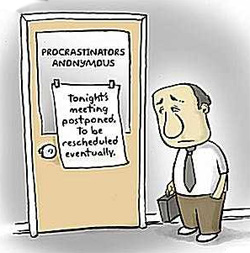
PROCASTINATION - HOW TO OVERCOME THIS WORKPLACE TIME THIEF

Is there a project you have been asked to take care of that has lingered for weeks and you pray everyday your boss will not ask you about? Is there colleague you need to talk to and the meeting was delayed by you for a day...which turned to a week...then a month? Are you finding yourself having to explain constantly why a, b, and or c has not been completed? Then this topic is for you.

CIVILITY IN THE WORK PLACE

As organizations have flattened and gone more “casual/informal” with people from all walks of life and disciplines working together under one roof, there are fewer norms as to what constitutes proper business behavior. Research has shown that most acts of workplace violence originate with uncivil behavior.

A modern work place is a hive of activity with employees often working under a great deal of pressure. Therefore it’s hardly surprising that tempers can often get frayed yet, whilst that might be understandable in certain instances, it should never be thought of as acceptable behavior. For instance: Gossiping/ Nastiness to your colleagues, subordinates or managers/ rude disposition or behavior/ Theft of other people’s food /Reading of colleagues emails/ Engaging in nasty emails, phone calls, and  or shouting matches are never acceptable and can cause you to lose respect, suffer serious stress or cause others around you unnecessary stress and tension and ultimately, will cost you your job.

WHY A CIVIL WORKPLACE IS IMPORTANT

If people are not civil to each other in the workplace, over time, not only will this have a detrimental effect on performance, it may also over time corrupt the culture & relationships within the office causing unnecessary tension, friction, anger, and resentment.

The following are ten tips to assist you in accomplishing this objective:
·      Before acting, consider the impact of your words and actions on others.
·       Create an inclusive work environment.  Only by recognizing and respecting individual differences and qualities can you fully realize the potential you find around you.
·      Self-monitor the respect that you display in all areas of your communications, including verbal, body language, and listening.
·       Understand your triggers or “hot buttons.”  Knowing what makes you angry and frustrated enables you to manage your reactions and respond in a more appropriate manner.
·     Take responsibility for your actions and practice self-restraint and anger management skills in responding to potential conflicts.
·         Adopt a positive and solution-driven approach in resolving conflicts.
·        Rely on facts rather than assumptions.  Gather relevant facts, especially before acting on  assumptions that can damage relationships.
·        Include others in your focus by considering their needs and avoiding the perception that you view yourself as the “center of the universe.”
·       View today’s difficult situations from a broader (big picture) and more realistic perspective by considering what they mean in the overall scheme of things.
·         Each one influence one” by becoming a bridge builder and role model for civility and respect. Act in a manner whereby you respect yourself, demonstrate respect for others, and take advantage of every opportunity to be proactive in promoting civility and respect in your workplace.

There can be numerous reasons connected to a lack of civility in the workplace. Long hours, unmanageable deadlines, added responsibilities placed upon us and longer and more stressful commutes to and from work are just some of the reasons we can get uptight at work. However, there never is nor will there ever be any excuse great enough to excuse prolonged uncivilized behavior in the office. Uncivilized behavior should always be checked by all of us. We spend most of our waking hours in the office and these hours should be as pleasant as possible. Remember the golden rule: “if you have nothing to say, DON’T say anything at all…!” Respect people’s boundaries at work; discuss only work related matters if you have not established clear guidelines for friendships at work, and even between colleagues themselves, simply saying ‘Thank You’ or “I really appreciate you doing that for me” can go a long way to easing tensions at work.

Have a great week! 

ANGER AND ANGER MANAGEMENT AT WORK

What is Anger?
Anger is a natural emotion. It's nature's way of telling us that something in our lives has gone haywire. Anger occurs as a defensive response to a perceived attack or threat to our well-being. In addition to psychological changes, like any emotion, anger is accompanied by physiological changes. When you get angry your adrenaline flows, your heart rate increases, and your blood pressure escalates. The phrase, "I'm so mad my blood is boiling" isn't that far from true when you fly into a rage!

Sometimes just our perception of a situation causes anger to ignite and sometimes the threat may be real. Whatever the case, anger isn't the problem. The problem with anger is that many of us don't learn to manage anger effectively. work place bullying, repressed rage, workplace violence, dififult bosses and colleagues and irate customers  are a few of the external examples of the results of poor anger management. Moreover, anger can lead to physical problems when not properly managed. Long-term anger has been linked to chronic headaches, sleep disorders, digestive problems, high blood pressure, and even heart attacks.
Yet, when you learn how to manage anger, it can be an accelerant towards positive change instead of a negative propeller towards disaster.

The Sequence of Anger

Anger is usually "triggered" by an occurrence, like stubbing your toe on an inanimate object or by something that someone says. Next, you think something like "what did I do to deserve that". However, at this point, emotion takes over your mind and the "pain" of the situation leads you to believe the answer to your question is "Nothing. I didn't deserve that at all!" Feelings of hurt and betrayal further try to override logic and you're ready to act on your anger by either suppressing it or expressing it. Suppressing your anger may lead you to believe you have it under control. However, suppressing anger doesn't solve your problem and is a dangerous type of anger management. Suppressed anger stays with you over time and can lead to mental health problems like depression, and physical problems like "stress" headaches and high blood pressure. Additionally, continually suppressing your anger can curtail your ability to act in the face of a real threat to your well-being.

ANGER MANAGEMENT

Anger needs to be expressed. Yet, aggressive displays of anger can result in violent eruptions that further hurt you socially, mentally, and physically. The goal of anger management is to help you find healthy ways to express your anger and resolve the problems that ignite it. Anger management is also very important in the office where you must do everything not to lose face at work, jeopordize your career, and handle situations where you anger MUST be supressed and expressed in a positive manner.

Tips  to help get your anger under control

      Breath Deep. Anger often begins when we feel weaker than we really are. Molehills loom like mountains. Taking a few deep breaths calms you, makes you feel stronger both mentally and physically, and you can cut those mountains down to size!
      Count to ten. Sounds simple, but counting to ten is an anger management tip that has worked for centuries! The Roman poet Horace (65 - 8 BCE) said, "When angry, count ten before you speak; if very angry, one hundred." Counting to ten (or one hundred) helps you to step back from the situation, buys time for you to examine the problem and decide on an effective, rational way to express your anger.
      Give yourself a break. It's easier to think when you're calm than when you're agitated. Leave the room, take a walk, 'whistle a happy tune'. Then come back to the problem, examine it, and solve it, and if necessary, take a break from the person you're angry with until your frustrations subside a bit.
      Get some exercise. Physical activity can provide an outlet for your emotions, especially if you're about to erupt. Go for a brisk walk or walk up and down a flight of stairs if you have one in the office, the exercise will distract you and help you clear your head.
      Think carefully before you say anything. Otherwise, you're likely to say something you'll regret. It can be helpful to write down what you want to say so that you can stick to the issues. When you're angry, it's easy to get sidetracked.
      Identify solutions to the situation. Instead of focusing on what made you mad, work with the person who angered you to resolve the issue at hand.
      Use 'I' statements when describing the problem. This will help you to avoid criticizing or placing blame, which can make the other person angry or resentful — and increase tension. For instance, say, "I'm upset you didn't help with the housework this evening," instead of, "You should have helped with the housework."
      Don't hold a grudge. If you can forgive the other person, it will help you both. It's unrealistic to expect everyone to behave exactly as you want.
      Use humor to release tensions. Lightening up can help diffuse tension. Don't use sarcasm, though — it's can hurt feelings and make things worse.
      Practice relaxation skills. Learning skills to relax and de-stress can also help control your temper when it may flare up. Practice deep-breathing exercises, visualize a relaxing scene, or repeat a calming word or phrase to yourself, such as "Take it easy." Other proven ways to ease anger include listening to music and writing in a journal. Even if your office has a no music policy, have a pair of earphones and sneak outside when you feel yourself flaring up. Some music and deep breaths will relax you in no time.

While the tips above can help you keep from blowing up, the best anger management strategy is to begin anger management when you're not inflated!

Have a great week everybody!

Friday, 20 April 2012

STRESS – THE ELEPHANT IN THE CORNER OF OUR OFFICE

It may seem that there’s nothing you can do about your stress level. Nigeria is a country on the verge of what I believe to be a positive breakthrough and change for the best, but our present situation is volatile, ever changing, and riddled with many issues. On a personal note, money or no money, the bills aren’t going to stop coming, there will never be more hours in the day for all your errands, and your career or family responsibilities will always be demanding. But you have a lot more control than you might think. Think about this, no matter how you fretm worry, or stress, that emotion in itself doesnt change anything!!! Yes you are human and you know what, i encourage everyone to know that there will be times where you need to pick up your boxing gloves or weights and just scream through some situations. However, after releasing all this negative energy, pick yourself up and know this....you’re in control of your life, there is always a solutions to every problem, and everybody on the face of this earth has what they can do to manage stress and remain happy, if they can only first take control of their mind and then implement a stress management plan thats right for them.

Managing stress is all about taking charge: taking charge of your thoughts, your emotions, your schedule, your environment, and the way you deal with problems. The ultimate goal is a balanced life, with time for work, relationships, relaxation, and fun – plus the resilience to hold up under pressure and meet challenges head on.

Stress management starts with identifying the sources of stress in your life. This isn’t as easy as it sounds. Your true sources of stress aren’t always obvious, and it’s all too easy to overlook your own stress-inducing thoughts, feelings, and behaviors. Sure, you may know that you’re constantly worried about work deadlines. But maybe it’s your procrastination, rather than the actual job demands, that leads to deadline stress.

To identify your true sources of stress, look closely at your habits, attitude, and excuses:
  • Do you explain away stress as temporary (“I just have a million things going on right now”) even though you can’t remember the last time you took a breather?
  • Do you define stress as an integral part of your work or home life (“Things are always crazy around here”) or as a part of your personality (“I have a lot of nervous energy, that’s all”). Do you say with pride " I'm losing my mind from being so busy!" with a sense of pride while in your heart of hearts you know you are decieving yourself and are deeply unhappy?
  • Do you blame your stress on other people or outside events, or view it as entirely normal and unexceptional?
If this sounds normal, please at this point, I beg you, look around to see who is sharing this stress with you.... oh its just you?!? Ask yourself, are you happy? fulfilled? satisfied? chances are, the answer will be no. I recently sent out a questionnare asking 100 participants what was the major cause of them missing deadlines, getting to work late, and fighting with coworkeds, 70% answered stress!! 70 out of a 100 people in a random selection were losing vast amounts of time they could be spending happy, productive, and working unhappy, simply because they hadnt accepted that stress was working against them and not for them.

It is important we understand that until you accept responsibility for the role you play in creating or maintaining it, your stress level will remain outside your control.

Easiest way of identifying stress?... remember that journal for your goals we talked about a while back? chances are it still has a few empty pages!! why not grab it and start a chapter titled:

MY STRESSORS

A stress journal can help you identify the regular stressors in your life and the way you deal with them. Each time you feel stressed, keep track of it in your journal. As you keep a daily log, you will begin to see patterns and common themes. Write down:
  • What caused your stress (make a guess if you’re unsure).
  • How you felt, both physically and emotionally.
  • How you acted in response.
  • What you did to make yourself feel better.

Look at how you currently cope with stress

Think about the ways you currently manage and cope with stress in your life. Your stress journal can help you identify them. Are your coping strategies healthy or unhealthy, helpful or unproductive? Unfortunately, many people cope with stress in ways that compound the problem.

Ok guys, go practice the exercise and meet me up in my next post about how to practically manage your stress.


CIAO!!